
Burn It All Down: The Case for a Workflow Revolution in Broadcast
Hossein Sharif
I have heard the same sentence three times in the past two years. On three different continents. In three different cities. From three different people, some editorial, some technical, all senior:
"Can we just burn it all to the ground?"
It is usually said after the second drink. It is usually said with a mixture of exhaustion and dark humor. And it is, I’d argue, one of the most revealing diagnostics in the broadcast industry today.
The fact that I keep hearing this tells me the relationship between storytellers and the technology built to serve them has broken down in a way that is systemic.
As we have been building up tools for our storytellers, something must’ve gone horribly wrong along the way.

The pattern is always the same: The technology changes, but not the workflow. The workflow changes, but not the rota. The rota changes, but not the job descriptions. And so on, in an endless chain of incomplete transformation, each link breaking exactly where the last one left off.
You cannot procure your way out of this. Because this is not a technology problem. AI will not fix it for you. It is a human and organizational problem, and if you want to fix it, you need to name it, acknowledge it and face it!
The scale of what goes unacknowledged is striking. In more than five years of engagements with some of the world's largest broadcasters, we have never walked into an organization with a workflow department. Not a single one. Technology departments, yes. HR departments, yes. Editorial teams, obviously. But workflow; the actual operating system that connects all three, belongs to no one!
Workflow is not the MAM. It is not the NRCS. It is not the playout or graphics system. It is the glue that connects all of them to your people: the configuration, the role, the job description, the rota, the hour people come in, the spatial geography of the floor. When nobody owns that glue, nobody maintains it. And when nobody maintains it, the frustration accumulates; shift by shift, bulletin by bulletin, until someone, honest enough to say what everyone else is thinking, suggests burning the whole thing down.
The impulse is not wrong. The arson is, but the recognition that incremental fixes applied to a broken architecture will not produce fundamental change is exactly right. What the industry needs is not another tool, another platform, another round of digital transformation. What it needs is a workflow revolution.
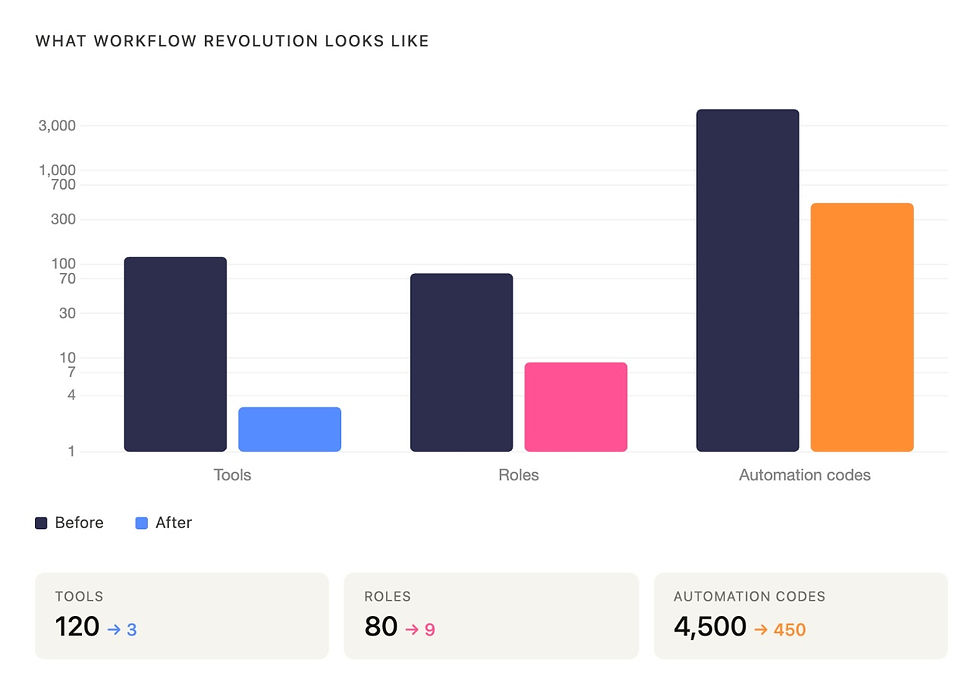
We know what that looks like in practice because we have built it. With our client in Sydney, Australia, 120 tools became 3. More than 80 roles were reimagined as 9; including job titles that had never existed before, written to match the demands of a modern, AI-connected newsroom.
We rebuilt every graphic template from editorial principles upward. We took 4,500 automation codes and brought them down to 450, built around stories rather than bulletins. We did it in sequence, from metadata design to launch and enforcement, with nothing left half-done.
The conversation about burning it all down stopped. The storytellers got back to telling stories.
Just last week, we helped launch the first ever StoryCentric and cloud-based news bulletin in the history of Australian broadcasting… and that’s just the beginning!
That is what we are building towards; for every broadcaster willing to stop patching and start redesigning. The workflow revolution has already started. The question is whether your organization joins it now, or waits until someone raises it again after the second drink.
As If Pictures is a workflow design and change management firm working with broadcasters across five continents.